
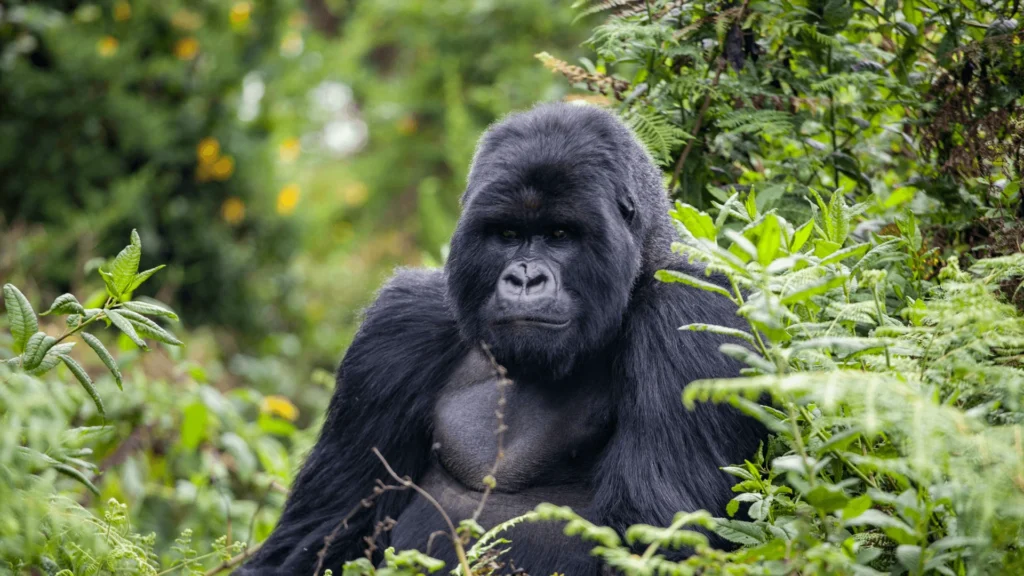
High in the mist-covered mountains of Volcanoes National Park in northern Rwanda, a rare and endangered species quietly holds the key to understanding how life, nature, and climate are deeply connected. These are the Virunga mountain gorillas—a species found only in a small region spanning Rwanda, Uganda, and the Democratic Republic of Congo (DRC). Fewer than 1,100 remain in the wild today.
Long-term research on over 160 gorillas living in the Rwandan section of the park has revealed surprising truths about their behavior—and what it means for global conservation efforts.
Take Mutesi, a calm female gorilla who lives in a small, close-knit family group. Her group enjoys stability and good health, but Mutesi has had very few babies in recent years.
Compare that to Ganza, a dominant silverback in a large, highly social group. Ganza is always surrounded by others—protecting, playing, and leading. His group has many offspring, but Ganza often struggles with illness, likely due to the stress and energy demands of leadership and social contact.
Researchers from European universities found that gorillas in large, social groups reproduce more—but are more prone to disease, while those in smaller groups stay healthier but produce fewer offspring.
These findings go far beyond gorilla behavior. They point to a delicate balance between connection and resilience—and reflect how climate change and environmental stress can influence the survival of entire species.
As the climate changes, so too does gorilla habitat. Warming temperatures, altered rainfall patterns, and shifting vegetation impact food availability and disease spread among gorilla families. These changes threaten not only the gorillas themselves but also the forest ecosystems they help maintain.
Mountain gorillas are what scientists call a “keystone species”—their survival supports the health of the forest, which in turn stores carbon, regulates rainfall, and protects biodiversity. By safeguarding these gorillas, we are also protecting natural climate solutions that benefit us all.
Robin Morrison, lead researcher from the University of Zurich, explains:
“Sometimes, solitude in animals like gorillas isn’t weakness—it’s a form of self-preservation. And sometimes, social living, while powerful, comes with invisible risks. This helps us understand the broader impact of environmental stress on group dynamics and health.”
Beyond the ecological value, mountain gorillas are a source of pride, identity, and income for Rwanda and the region. Gorilla tourism generates hundreds of millions of dollars annually, including over $647 million in Rwanda alone, boosting local communities and funding conservation.
As the world looks for solutions to the climate crisis, the story of Mutesi and Ganza reminds us:
Protecting endangered species isn’t just about saving animals—it’s about restoring balance between people, wildlife, and the planet.
And in the Virunga mountains, that balance is fragile, beautiful, and worth every effort to preserve.
By SECOTO MAGAZINE/EAC