
By Jean de Dieu Nduwayezu
Kigali, October 28, 2025
The hum of engines across Kigali’s busy roads masks a silent threat rising in the air — pollution from vehicles that have gone unchecked for far too long. Beneath the rhythm of urban transport lies a growing environmental challenge that Rwanda is no longer willing to ignore.
This week, the Ministry of Environment reaffirmed strict measures that will see vehicle owners face heavy fines — some reaching up to five million Rwandan francs — if they fail to comply with mandatory emissions testing. The new regulations, established under a Ministerial Order issued on August 25, 2025, mark a turning point in the country’s battle for cleaner air.
Authorities warn that air quality in urban centers is deteriorating, largely due to fine particulate matter known as PM2.5, a by-product of fuel combustion. These microscopic particles are among the most harmful to human health, contributing to chronic respiratory and cardiovascular illnesses.
Under the new order, all motor-powered vehicles — from passenger cars and delivery trucks to school buses, motorcycles, and construction machinery — must undergo regular emissions inspections.
Some vehicles will be certified for six months, others for a full year, depending on their category and environmental risk. If an inspection reveals faults or excessive exhaust emissions, the vehicle owner must repair the problem and return for re-testing before receiving certification.
Failure to comply will come at a steep cost. The fines vary according to the type of violation:
- RWF 25,000 for vehicle owners who ignore emission standards.
- RWF 3 million for individuals or companies operating polluting activities without authorization.
- RWF 5 million for those who disregard an environmental stop order.
Those fined will have seven days to pay into the national Environment and Climate Change Fund, after which an additional daily surcharge of 0.5% will apply for delays.
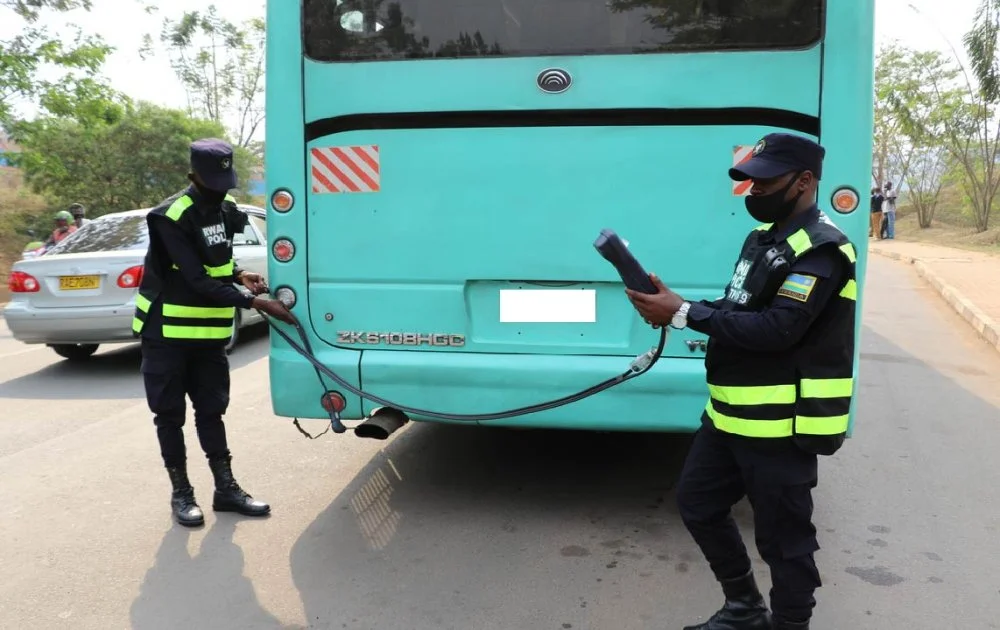
The emissions testing program also comes with set inspection fees. A motorcycle test costs RWF 16,638, while a follow-up after repairs costs RWF 8,319. Passenger vehicles pay RWF 34,940, or RWF 17,470 if they return for a second inspection within two weeks. Larger vehicles — such as buses and trucks — pay between RWF 49,000 and 51,000, depending on their size and purpose.
Officials insist that these costs are minor compared to the long-term damage caused by air pollution. According to the Ministry, motorcycles account for nearly 47% of total vehicle emissions in Rwanda, a statistic that has accelerated the government’s campaign to promote electric mobility.
Already, e-motorcycles are gaining ground across Kigali, supported by new charging infrastructure and tax incentives. The shift signals a broader transformation in Rwanda’s transport ecosystem — one that aligns public health goals with green innovation.
For a country long praised for its environmental discipline, from banning plastic bags to pioneering urban cleanliness, this latest move underscores Rwanda’s determination to protect its atmosphere as it modernizes.
Yet the success of the emissions policy will depend not only on enforcement but on awareness. Mechanics, drivers, and fleet operators must all understand that cleaner air is now both a shared duty and a legal demand.
As the sun sets over Kigali’s rolling hills, the hum of traffic carries a message of accountability: every engine that turns must now respect the air we share. Rwanda’s drive for clean transport is no longer a distant vision — it is the road ahead.