
By Jean de Dieu NDUWAYEZU | Kigali, November 2, 2025
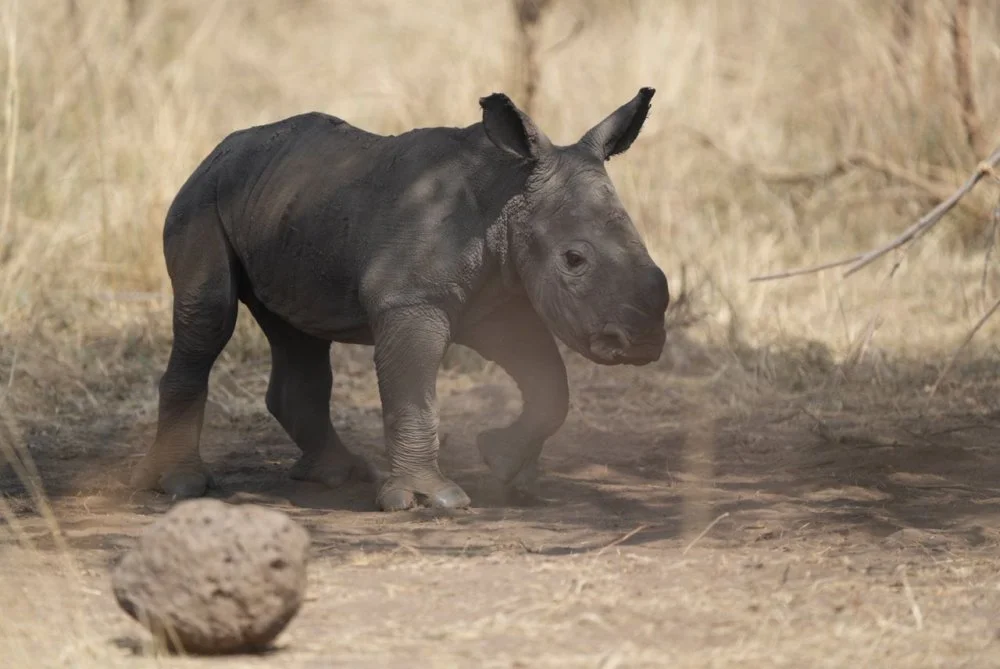
Rwanda has once again written a new chapter in Africa’s conservation story. Akagera National Park has confirmed the birth of its first white rhino calf, one of 70 rhinos relocated from South Africa in June 2025. It is more than a birth — it is a sign of resilience, a symbol of how far Rwanda has come in restoring its natural heritage.
“We are proud to announce the birth of the first white rhino calf born in the wild from the herd translocated to Akagera National Park. The mother and calf are both healthy and thriving,”
— Akagera National Park Management.
The 70 rhinos — 28 males and 42 females — undertook a 3,400-kilometer journey from South Africa, one of the largest and most ambitious wildlife translocations ever attempted. The mission, worth nearly seven million dollars, was made possible through the collaboration of the Rwanda Development Board, the Howard G. Buffett Foundation, and African Parks Network.
Each rhino, weighing up to three and a half tons, represents more than a conservation success — it stands as a living legacy of science, partnership, and hope. Their arrival and now the birth of a new generation affirm that Rwanda’s approach to wildlife protection is not only working but inspiring the continent.
The country’s last rhino was lost to poaching in 2007, ending an era of silence in its savannahs. A decade later, in 2017, black rhinos returned — 18 of them, reintroduced from South Africa through the same partnership. Then came the white rhinos, a species that had never before roamed Rwandan soil. Thirty arrived in 2021, followed by 70 more in 2025. With this birth, their number now exceeds 41, alongside 34 black rhinos thriving in Akagera’s vast landscapes.
This success cements Rwanda’s role as a beacon of conservation leadership in Africa — a nation where vision, community, and science work hand in hand.
“The birth of this calf is a victory for Africa,” said a conservationist at African Parks. “It shows what happens when nations unite to protect what belongs to us all.”
We see this as more than a milestone — it is proof that sustainability grows where resilience is rooted. From extinction to expansion, Akagera’s story is one of hope reborn.